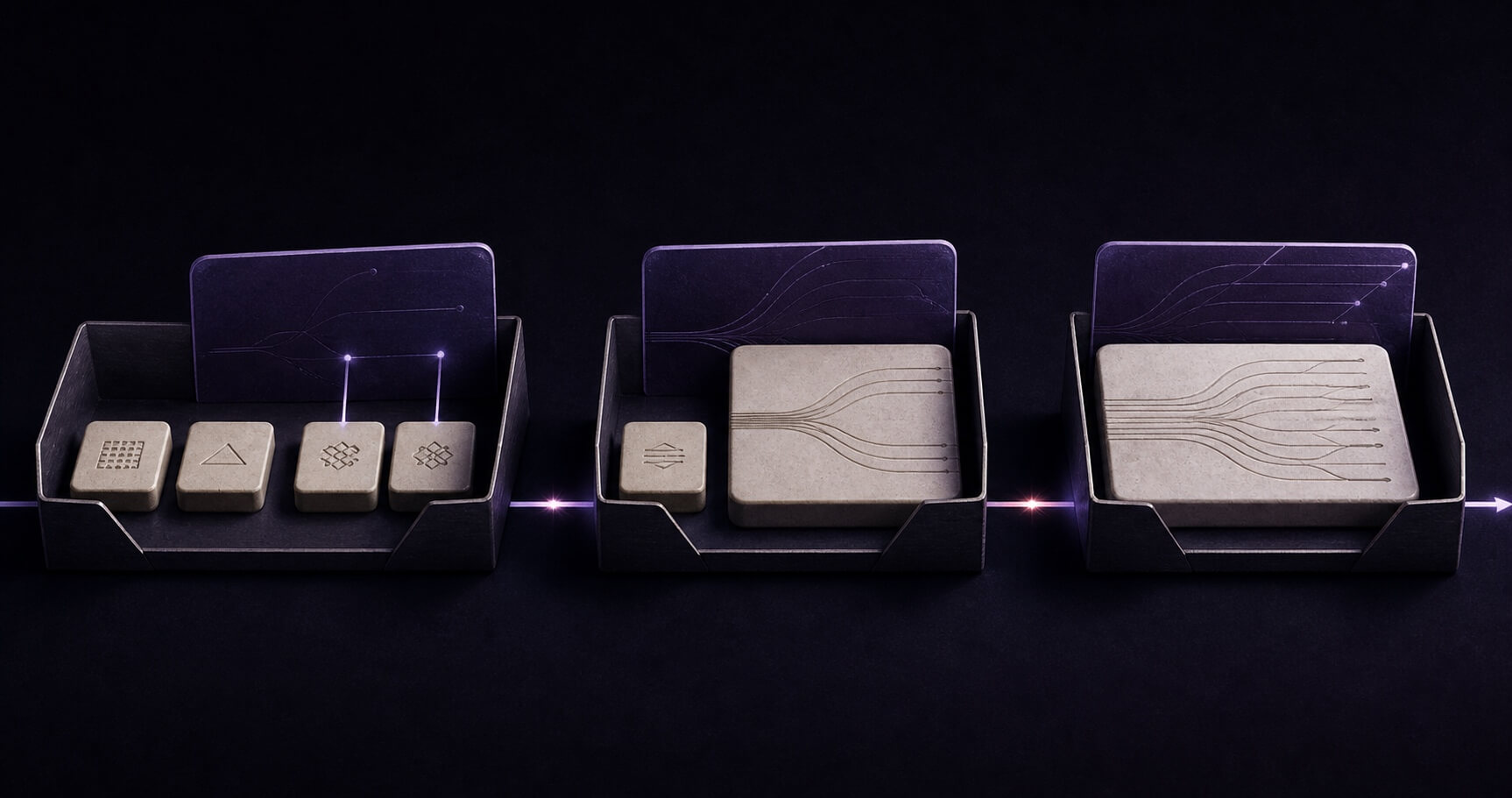
How MLX Packs Metal Command Buffers
A source-based account of operation limits, element accounting, and launch planning on an M1 Max running macOS 26.5
A chain of Metal kernels is not necessarily one Metal command buffer. That distinction matters when software estimates whether a long GPU workload is safe to submit.
mlx-train-perf initially guarded its tiled attention backward by adding the projected duration of
every dispatch in the chain. Once the sum exceeded two seconds, the launcher refused the shape. The
guard was conservative, but it was built around the wrong scheduling unit. MLX 0.32.0 commits a command
buffer once the operations and unique tensor elements accumulated in it cross configured thresholds. At
the attention shapes that motivated the guard, a single backward dispatch already exceeds the element
threshold. Each such dispatch is therefore commit-triggering, and successive large attention
dispatches cannot share a buffer. The duration of the full chain is not the duration of one packed
buffer.
This article explains that packing rule, applies it to real attention dispatches, and separates three kinds of evidence: facts visible in MLX source, behavioral observations reported by the project, and an inference about why macOS terminates some long-running GPU work. It does not rerun the original experiments. Measurements are source-reported and cross-checked against the project README and changelog.
Evidence scope
- Project release:
mlx-train-perf0.3.0, documented 2026-07-14. - Runtime: MLX 0.32.0 wheel.
- Machine: Apple M1 Max, 32 GB, reported as
applegpu_g13s, running macOS 26.5. - Verification method: pinned MLX 0.32.0 source, cross-checked against the public 0.3.0 README and changelog; the probe observations are source-reported, with no code or benchmark reruns.
1. Why the scheduling unit matters
Memory-efficient attention avoids materializing the full score matrix by dividing forward and backward work into tiles. A single logical backward can therefore become a chain of custom-kernel dispatches. Each dispatch has a projected cost, and a launcher can split the work until no individual piece exceeds a safety budget.
The first mlx-train-perf attention launcher also imposed a total-chain budget:
reject if projected duration of one dispatch > per-dispatch budget
reject if sum of projected durations in the chain > total-chain budget
The second rule assumed that consecutive dispatches remained together in one command buffer, or that macOS judged the cumulative duration of the whole evaluation. Under that model, splitting one unsafe dispatch into several safe pieces did not help for long contexts: the sum still grew until the chain was refused.
This created an apparent RAM-independent context ceiling. Attention memory had been reduced, but the launcher would not use the new headroom. The important question was no longer "how long is the chain?" It was "what work does MLX actually place in each command buffer?"
2. The rule in MLX 0.32.0
The pinned MLX 0.32.0 Metal backend maintains two counters while encoding a command buffer:
- the number of encoded operations;
- the number of elements in unique input and output buffers.
After encoding an operation, MLX checks whether either counter has crossed the limit for the detected Apple GPU architecture. If so, it commits the command buffer and resets the accounting for the next one.
For the applegpu_g13s architecture reported by the tested M1 Max, the source-recorded configured
limits are 50 operations and 50 shifted element units. The comparison is strict: a commit is needed
when the operation count is greater than 50 or when floor(elements / 2²⁰) is greater than 50. The
first triggering values are therefore 51 operations or 51 × 2²⁰ = 53,477,376 elements.
The second counter is easy to misread. MLX names it with MB, but the source adds
array.data_size(), which is measured in elements rather than bytes. The "50 mega-elements" label is
only shorthand for the shifted-unit rule above; the first triggering count is not 50,000,000. The same
element count also represents different byte totals for bfloat16, float32, or another dtype. It is a
scheduling counter, not a fixed memory-capacity limit.
MLX counts a unique backing-buffer pointer once between commits. This is identity-based bookkeeping, not semantic tensor-liveness analysis: a short-lived referenced buffer still counts, while aliased arrays may share one backing-buffer identity. Shared backing buffers are not added again for every operation in the same command buffer. After a commit, the unique-buffer set and both counters reset, so buffers referenced by later dispatches are counted again.
These are source facts for MLX 0.32.0. They should not be generalized to later MLX versions or other architecture classes without checking their corresponding source.
3. Applying the rule to tiled attention
The source-reported calculation used the following flagship training shape:
batch                 1
query heads          32
key/value heads       8
sequence length    8192
head dimension      128
compute dtype     bfloat16
The source-reported arithmetic is:
| dispatch class | unique input and output elements | shifted units | packing consequence |
|---|---|---|---|
backward dK/dV range |
about 118 million | 112 | one dispatch crosses the threshold |
backward dQ range |
about 85 to 89 million | 81 to 85 | one dispatch crosses the threshold |
| MMA forward range, about 5,400 rows | about 73 million once the first range is encoded | 69 | one dispatch crosses the threshold |
| scalar forward range, about 117 rows | 48 units plus about 0.46 per dispatch | crosses 50 near the fifth | roughly 4 to 6 dispatches can pack |
The dK/dV row can be reconstructed from the tensor shapes above, assuming the distinct backing
buffers used by that measurement:
q + dO                              2 × (1 × 32 × 8192 × 128) =  67,108,864
k + v + dk_in + dv_in + dk_out + dv_out
                                    6 × (1 ×  8 × 8192 × 128) =  50,331,648
lse + D                             2 × (1 × 32 × 8192)       =     524,288
total                                                               117,964,800 elements
floor(total / 2²⁰)                                                        112 units
Because 112 is already over the configured 50-unit limit, MLX commits after encoding that dispatch. The next range starts a new accounting window and references the large shared buffers again. By contrast, the scalar forward begins near 48 units; shared backing buffers count only once within that window, while each new range adds about 0.46 units of new output storage. The shifted counter crosses 50 after several ranges, which produces the reported 4-to-6-dispatch estimate.
The large backward ranges are the decisive case. Their referenced unique backing buffers already exceed the element threshold after one encoded operation. Once MLX checks the counters, it commits. Successive large ranges therefore cannot share a command buffer, although a large range may still follow smaller framework operations in the buffer it closes. No published Metal capture directly observed those surrounding boundaries.
Small-footprint work behaves differently. Several scalar forward ranges can stay under both limits and pack together. A safe planner cannot simply delete all cumulative accounting. It must accumulate projected work within each modeled command buffer, commit the model when either MLX threshold is crossed, and then begin a fresh buffer model.
4. What the behavioral probes add
Source inspection tells us what MLX intends to count. On 2026-07-14, the project also recorded three subprocess-per-condition behavioral checks against the shipped 0.32.0 wheel on the M1 Max running macOS 26.5. These are qualitative consistency checks, not measurements of the exact threshold or an isolated overhead component.
First, a chain of 2,000 small serial matrix multiplications took 0.0180 seconds under the default configuration. Forcing a boundary after every operation increased the time to 0.0510 seconds, or 2.8× the default. Raising the operation threshold to 5,000 produced 0.0235 seconds, which is slower than the default despite allowing fewer expected commits. The forced-every-operation contrast is consistent with aggregate overhead from more frequent commits, but the non-monotonic third point does not isolate that overhead or establish the exact threshold. The threshold semantics come from source.
Second, 200 serial additions over roughly 13 million elements took 0.0875 seconds by default, 0.0857 seconds with a very high element threshold, and 0.0937 seconds when every operation was forced across a boundary. The unreplicated spread is small, but its direction is consistent with the element-accounting model.
Third, a real chained dK/dV backward at 12,288 tokens used twelve 1,024-row ranges. Its full chain
was projected at roughly 4.3 seconds, beyond the retired total-chain cap. The project reports that it
completed in 0.781 seconds wall time, returned finite outputs, and reached a 1.56 GB peak. The element
arithmetic predicts that every large range triggers a commit at that shape.
These probes support the practical consequence of the source rule. They do not directly expose Metal command-buffer boundaries, nor do they reveal the operating system's internal watchdog decision.
5. From a chain budget to a packing-aware planner
The mlx-train-perf 0.3.0 planner made two orthogonal corrections. First, it replaced a rectangular
N × N work estimate with the causal triangular MAC count for the actual query range. The retired
estimate priced masked work that the kernel never executes and could be roughly twofold pessimistic.
Second, it accumulated those corrected dispatch projections over modeled command-buffer windows rather
than over the whole logical chain.
For every planned dispatch, it estimates:
- exact causal work for the query range and its projected duration;
- elements in guaranteed-distinct backing buffers referenced by the current modeled buffer;
- output buffers only when the caller retains them, which guarantees that they cannot be recycled into the same identity during the modeled window;
- the current buffer's operation count.
MLX itself does not count "live tensors"; it counts backing-buffer identities encountered since the last commit. The planner uses caller-held references as a conservative way to identify buffers that are guaranteed to remain distinct. It does not credit short-lived intermediate outputs when allocator recycling could make their identities uncertain, because falsely predicting an early commit would be the unsafe direction.
If the next dispatch would make the modeled buffer exceed its time allowance, the planner shortens the range. When the modeled operation or element count crosses MLX's commit threshold, the next dispatch starts with fresh buffer counters and a fresh time budget.
The planner therefore no longer rejects work solely because total chain duration exceeds two seconds. Every modeled buffer must still stay within the conservative allowance, and memory, thermal state, end-to-end latency, or other runtime limits can still bound the chain. Small dispatches that can pack together share one allowance; the planner cannot pretend that every custom-kernel call gets its own buffer.
The change did not raise the project's safety margin. The 0.3.0 release record reports that the measured kernel rate is multiplied by the same 0.5 calibration safety factor, making projected duration about twice the estimate at the raw measured rate. Each modeled buffer is then capped at the same 0.5-second projected duration. What changed was the causal work estimate and the window over which those projections accumulate.
6. What is known, and what remains an inference
The evidence supports several claims with different confidence levels.
Directly established from pinned source: MLX 0.32.0 checks operation and unique-element counters; the M1 Max architecture class uses 50/50 thresholds; inputs and outputs contribute elements; commits reset the accounting.
Supported by source arithmetic and behavioral observations: large attention-backward dispatches cross the element threshold individually, while several smaller forward dispatches may pack; the forced-boundary timings are qualitatively consistent with aggregate commit overhead; a long chain of commit-triggering dispatches can execute despite exceeding the retired chain-total budget.
Inferred rather than directly observed: macOS interactivity kills are governed by the non-preemptible occupancy of an individual command buffer, with display contention affecting the boundary. This model reconciles the project's reported kill history and an external MLX issue, but the probes do not instrument the watchdog itself. It should remain a mechanism hypothesis, not be presented as an Apple-documented law.
7. Limits and transferability
The packing constants and dispatch arithmetic are pinned to MLX 0.32.0 and an M1 Max reported as
applegpu_g13s. MLX may change its counters, thresholds, architecture mapping, or commit behavior.
Donation, aliasing, and framework operations inserted between custom kernels may also affect which
buffers are counted. Extra intervening work tends to cause earlier commits, but that conservative
direction should still be checked when adapting the planner.
The behavioral timings are source-reported single-machine observations, not a statistical performance analysis. They are consistent with the packing model; they do not define universal fence costs or watchdog thresholds.
The durable lesson is methodological. For this MLX/macOS configuration, modeled command-buffer windows are a better operational proxy than whole-chain duration. Pinned runtime source should establish how work is submitted before cumulative timing rules become product limits; whether that submission unit also governs an operating-system kill remains a separate empirical question.
References and source notes
- MLX 0.32.0
device.cpp: backing-buffer identity and size accounting, operation counting, theneeds_commit()rule, and the architecture-specific thresholds. Section 3 shows the attention-shape arithmetic derived from these rules; the probe observations are source-reported, with the public method linked below. mlx-train-perf0.3.0 changelog and release README, used as independent documentary cross-checks.scripts/probe_command_buffer_packing.py, the recorded probe method; this article did not rerun it.- ml-explore/mlx issue #3267, an external report of LoRA fine-tuning kills at roughly 1.2-second individual operations with the display active; used only in the watchdog-mechanism reconciliation.
- Apple
MTLCommandBufferError, documentation for Metal command-buffer error classes; it does not establish this article's inferred watchdog boundary.
Prepared 2026-07-15. Last updated 2026-07-20. Denis Ineshin.